

Written and reviewed by Dr Ali Zad, FRACP gastroenterologist, Brisbane. Last reviewed November 2026 against current Australian and international guidelines. General information only, not a substitute for personal medical advice.
Barrett’s oesophagus develops after years of reflux. Read about what causes acid reflux.
On this page
What is Barrett’s oesophagus?
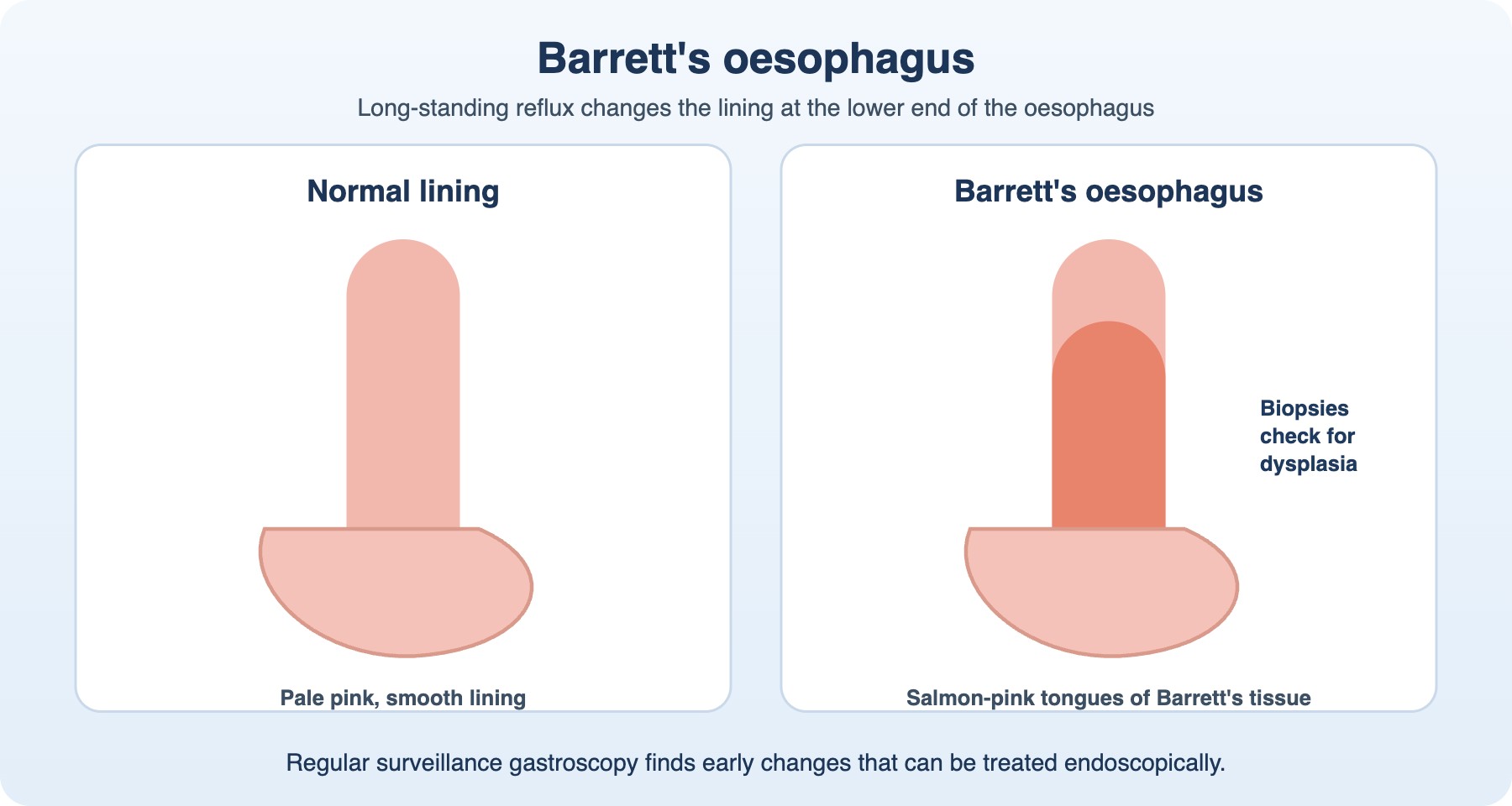
Barrett’s oesophagus is a change in the lining of the lower oesophagus caused by long-standing reflux. The normal lining is replaced by tissue similar to the lining of the bowel. It is diagnosed with a gastroscopy and biopsies.
Does Barrett’s oesophagus mean I will get cancer?
No. Most people with Barrett’s oesophagus never develop cancer. For Barrett’s without dysplasia the risk of progressing to cancer is low (well under 1% per year), which is why regular monitoring rather than surgery is recommended.
Guideline: Cancer Council Australia Barrett’s Oesophagus Guidelines.
How is Barrett’s oesophagus monitored and treated?
Treatment includes controlling reflux, usually with a PPI. For Barrett’s without dysplasia, Australian guidance recommends a surveillance gastroscopy with biopsies about every 3 years for short segments (under 3 cm) and every 2 to 3 years for longer segments. If pre-cancerous changes (dysplasia) are found, they can usually be treated endoscopically, and surveillance becomes more frequent.
Guideline: Cancer Council Australia Barrett’s Oesophagus Guidelines, as adopted by Safer Care Victoria.
Related procedures and information
- Gastroscopy with Dr Ali Zad
- 24-hour pH monitoring with Dr Ali Zad
- All digestive health questions and answers
- Patient education videos
Book an appointment
If you have symptoms of barrett’s oesophagus, see your GP or book a consultation with gastroenterologist Dr Ali Zad on (07) 2111 2600 or request an appointment online. You can book directly; a GP referral is needed for a Medicare rebate.
Dr Zad consults and performs procedures across Brisbane and Moreton Bay: Brisbane City and Spring Hill, North Lakes, Caboolture, Everton Park, Taringa and Redcliffe and Kippa-Ring.