

Written and reviewed by Dr Ali Zad, FRACP gastroenterologist, Brisbane. Last reviewed November 2026 against current Australian and international guidelines. General information only, not a substitute for personal medical advice.
Food sticking can be linked to reflux. See what causes acid reflux and when to worry.
On this page
What causes difficulty swallowing?
Common causes include narrowing from reflux, eosinophilic oesophagitis, a ring or web, motility disorders such as achalasia, and less commonly a tumour. Problems starting a swallow, with coughing or choking, can also come from the throat or nerves.
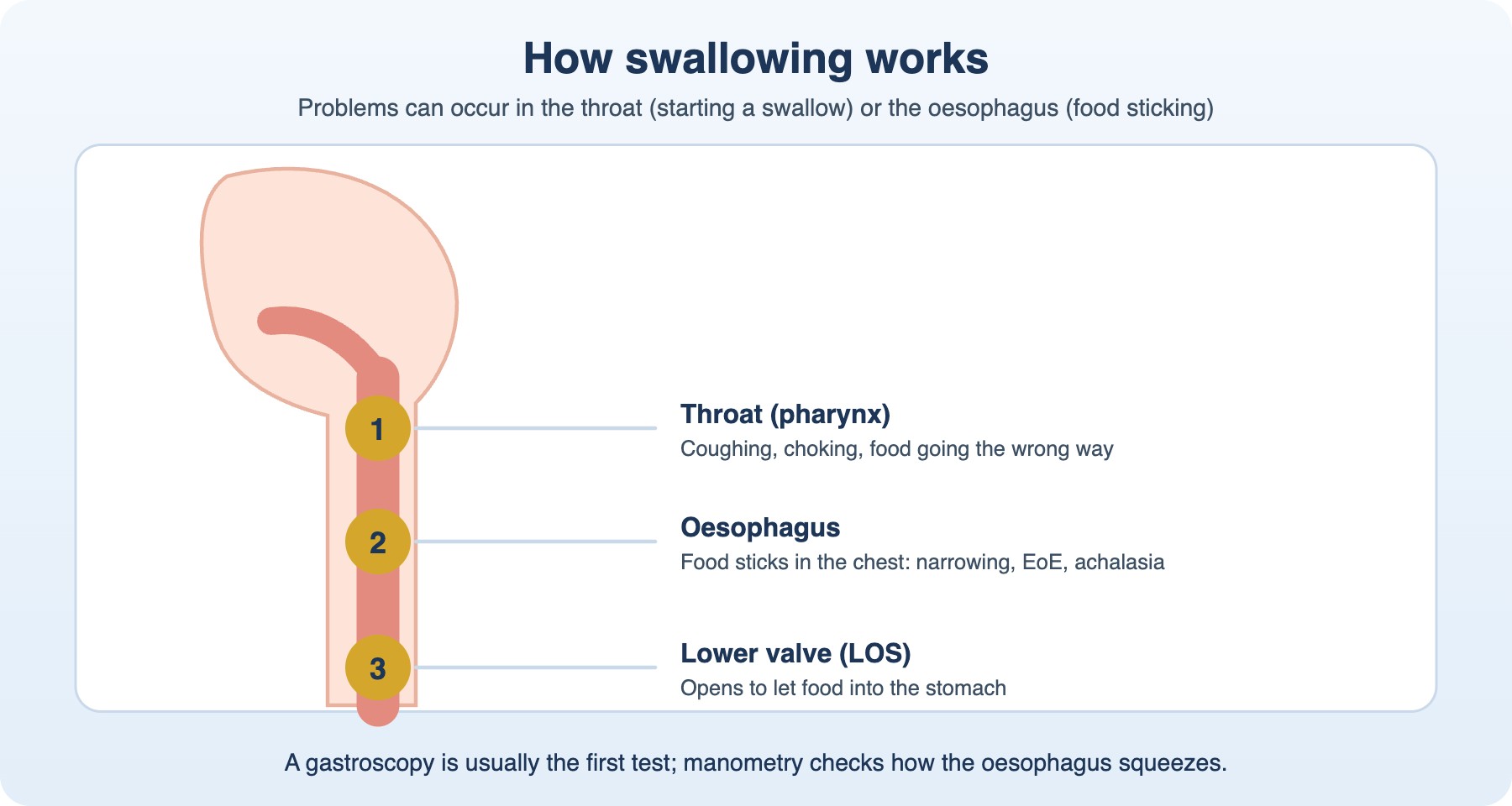
Is difficulty swallowing serious?
Swallowing difficulty should always be checked, especially if it is getting worse, involves solid food sticking, or comes with weight loss, vomiting or bleeding. Seek urgent care if food is completely stuck and you cannot swallow your saliva.
How is it investigated?
A gastroscopy is usually the first test, as it can find and often treat a narrowing at the same time. If the gastroscopy is normal, high-resolution oesophageal manometry assesses how the muscles of the oesophagus work. A barium swallow X-ray is sometimes used.
Related procedures and information
- Gastroscopy with Dr Ali Zad
- Oesophageal manometry with Dr Ali Zad
- All digestive health questions and answers
- Patient education videos
Book an appointment
If you have symptoms of difficulty swallowing, see your GP or book a consultation with gastroenterologist Dr Ali Zad on (07) 2111 2600 or request an appointment online. You can book directly; a GP referral is needed for a Medicare rebate.
Dr Zad consults and performs procedures across Brisbane and Moreton Bay: Brisbane City and Spring Hill, North Lakes, Caboolture, Everton Park, Taringa and Redcliffe and Kippa-Ring.