
Written and reviewed by Dr Ali Zad, FRACP gastroenterologist, Brisbane. Last reviewed November 2026 against current Australian and international guidelines. General information only, not a substitute for personal medical advice.
On this page
- What is the difference between internal and external haemorrhoids?
- What are the grades of internal haemorrhoids?
- What causes internal haemorrhoids?
- Can internal haemorrhoids go away on their own?
- What is rubber band ligation?
- Is banding painful and how is recovery?
- Will haemorrhoids come back after banding?
- Should I have a colonoscopy if I think the bleeding is from haemorrhoids?
What is the difference between internal and external haemorrhoids?
Internal haemorrhoids form inside the lower rectum, above an area with few pain nerves, so they usually cause painless bleeding or prolapse. External haemorrhoids form under the skin around the anus and can be itchy or painful, especially if a clot forms (thrombosed haemorrhoid).
What are the grades of internal haemorrhoids?
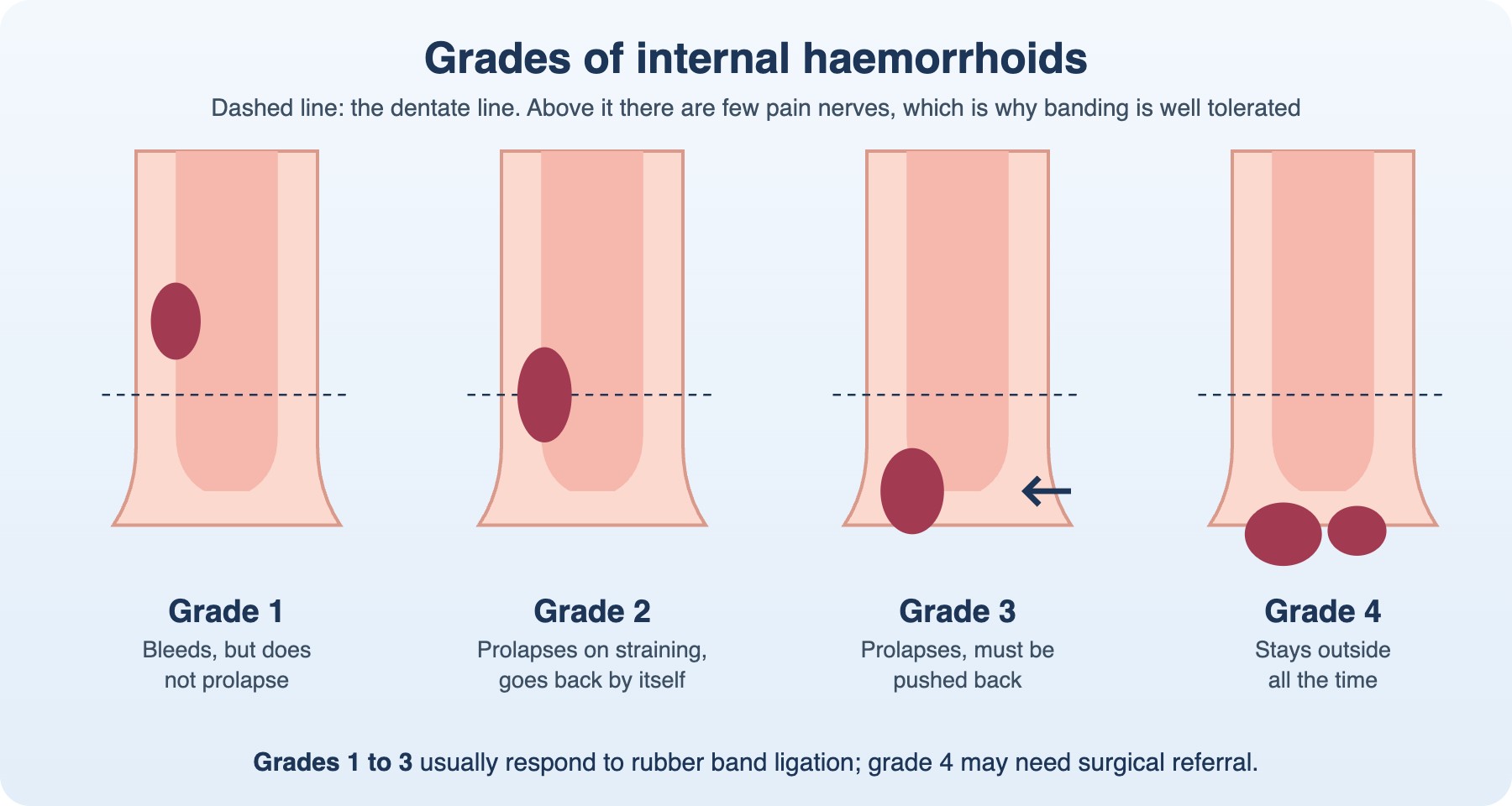
Grade 1 haemorrhoids bleed but do not prolapse. Grade 2 prolapse when straining but go back on their own. Grade 3 prolapse and need to be pushed back. Grade 4 stay prolapsed. The grade helps guide treatment.
What causes internal haemorrhoids?
Common causes are straining due to constipation, sitting on the toilet for long periods, chronic diarrhoea, pregnancy, heavy lifting and ageing of the supporting tissues. A low-fibre diet makes them more likely.
Can internal haemorrhoids go away on their own?
Small haemorrhoids often settle with softer stools, more fibre and fluids, and not straining or sitting on the toilet for long. Haemorrhoids that keep bleeding or prolapsing usually need treatment.
What is rubber band ligation?
A small elastic band is placed around the base of an internal haemorrhoid, cutting off its blood supply so it shrinks and falls off within about one to two weeks. It is quick, does not need cutting, and can often be done during a colonoscopy. A dull ache or mild bleeding for a few days is common.
Is banding painful and how is recovery?
Because internal haemorrhoids sit above the sensitive area, banding usually causes only a feeling of pressure or a dull ache for a day or two, eased with simple pain relief. Most people return to normal activities the next day. Avoid straining, and contact us if you have heavy bleeding, fever or severe pain.
Will haemorrhoids come back after banding?
Banding is effective for most people, but haemorrhoids can recur, and more than one session is sometimes needed. Keeping stools soft with fibre and fluids and avoiding straining helps prevent them coming back. Large or external haemorrhoids may need referral for surgery.
Should I have a colonoscopy if I think the bleeding is from haemorrhoids?
Rectal bleeding should not be assumed to be from haemorrhoids. A colonoscopy is recommended if you are 45 or older, have a family history of bowel cancer, a change in bowel habit, iron deficiency or bleeding mixed with the stool. Haemorrhoids can be banded during the same colonoscopy.
Related procedures and information
- Haemorrhoid banding with Dr Ali Zad
- Colonoscopy with Dr Ali Zad
- All digestive health questions and answers
- Patient education videos
Book an appointment
If you have symptoms of internal haemorrhoids and banding, see your GP or book a consultation with gastroenterologist Dr Ali Zad on (07) 2111 2600 or request an appointment online. You can book directly; a GP referral is needed for a Medicare rebate.
Dr Zad consults and performs procedures across Brisbane and Moreton Bay: Brisbane City and Spring Hill, North Lakes, Caboolture, Everton Park, Taringa and Redcliffe and Kippa-Ring.