
Written and reviewed by Dr Ali Zad, FRACP gastroenterologist, Brisbane. Last reviewed November 2026 against current Australian and international guidelines. General information only, not a substitute for personal medical advice.
Achalasia can be mistaken for reflux. Compare with acid reflux symptoms and causes.
What is achalasia?
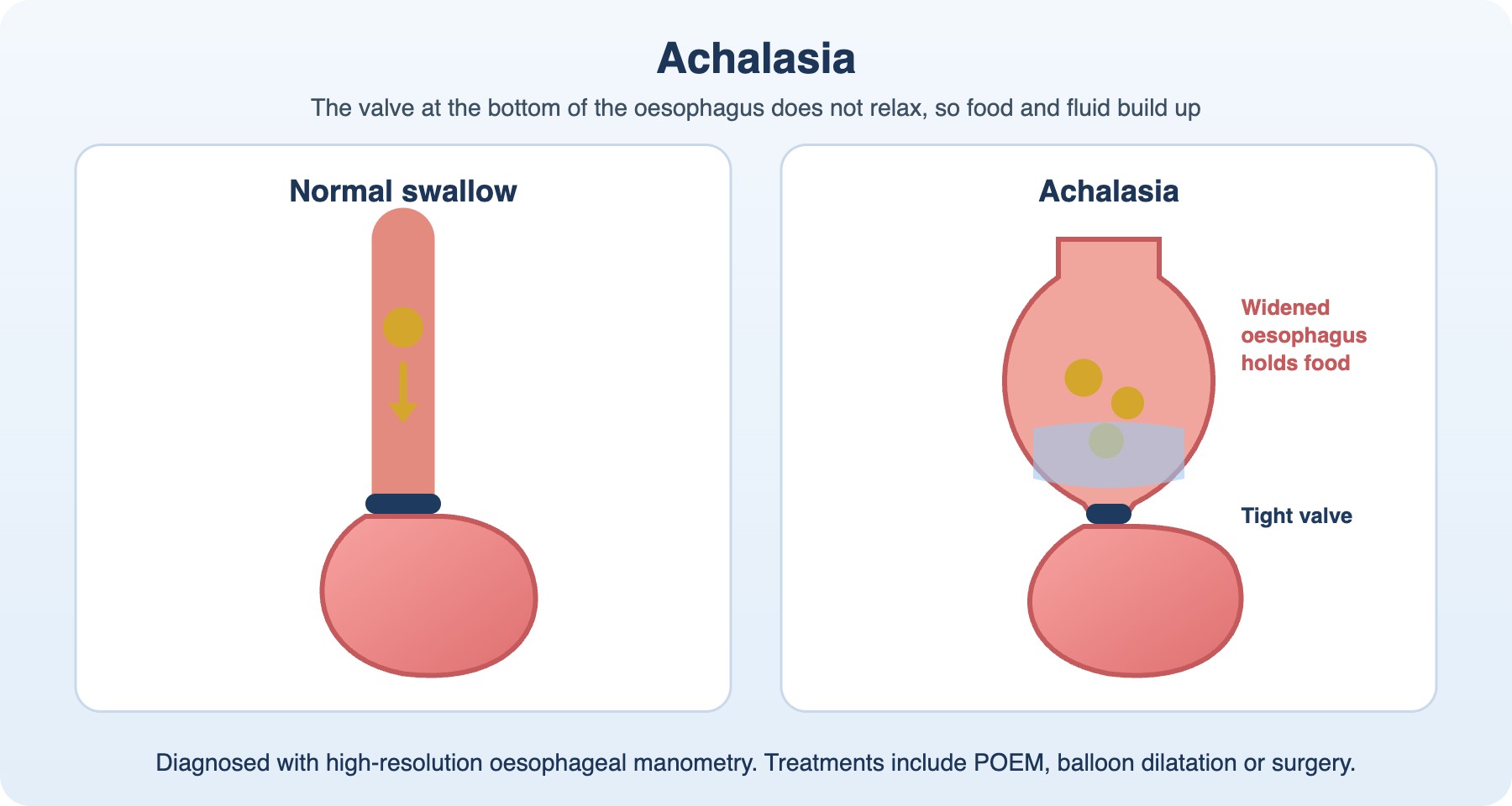
Achalasia is an uncommon condition where the valve at the bottom of the oesophagus does not relax properly and the oesophagus does not squeeze normally. Food and liquid can build up in the oesophagus.
What are the symptoms?
Symptoms include difficulty swallowing both solids and liquids, regurgitation of undigested food, chest pain, coughing at night and weight loss. It is sometimes mistaken for reflux.
How is achalasia diagnosed and treated?
High-resolution oesophageal manometry is the key test, together with a gastroscopy and sometimes a timed barium swallow. Treatments include balloon dilatation, keyhole surgery (Heller myotomy) or an endoscopic procedure called POEM, which have similar success in experienced hands. Botulinum toxin injection gives shorter-term relief for people not suited to other options. The best choice depends on the type of achalasia and your overall health.
Guideline: ACG Clinical Guideline: Achalasia (2020); Chicago Classification v4.0.
Related procedures and information
- Oesophageal manometry with Dr Ali Zad
- Gastroscopy with Dr Ali Zad
- All digestive health questions and answers
- Patient education videos
Book an appointment
If you have symptoms of achalasia and oesophageal motility disorders, see your GP or book a consultation with gastroenterologist Dr Ali Zad on (07) 2111 2600 or request an appointment online. You can book directly; a GP referral is needed for a Medicare rebate.
Dr Zad consults and performs procedures across Brisbane and Moreton Bay: Brisbane City and Spring Hill, North Lakes, Caboolture, Everton Park, Taringa and Redcliffe and Kippa-Ring.