

Written and reviewed by Dr Ali Zad, FRACP gastroenterologist, Brisbane. Last reviewed November 2026 against current Australian and international guidelines. General information only, not a substitute for personal medical advice.
On this page
What are lactase, sucrase and maltase?
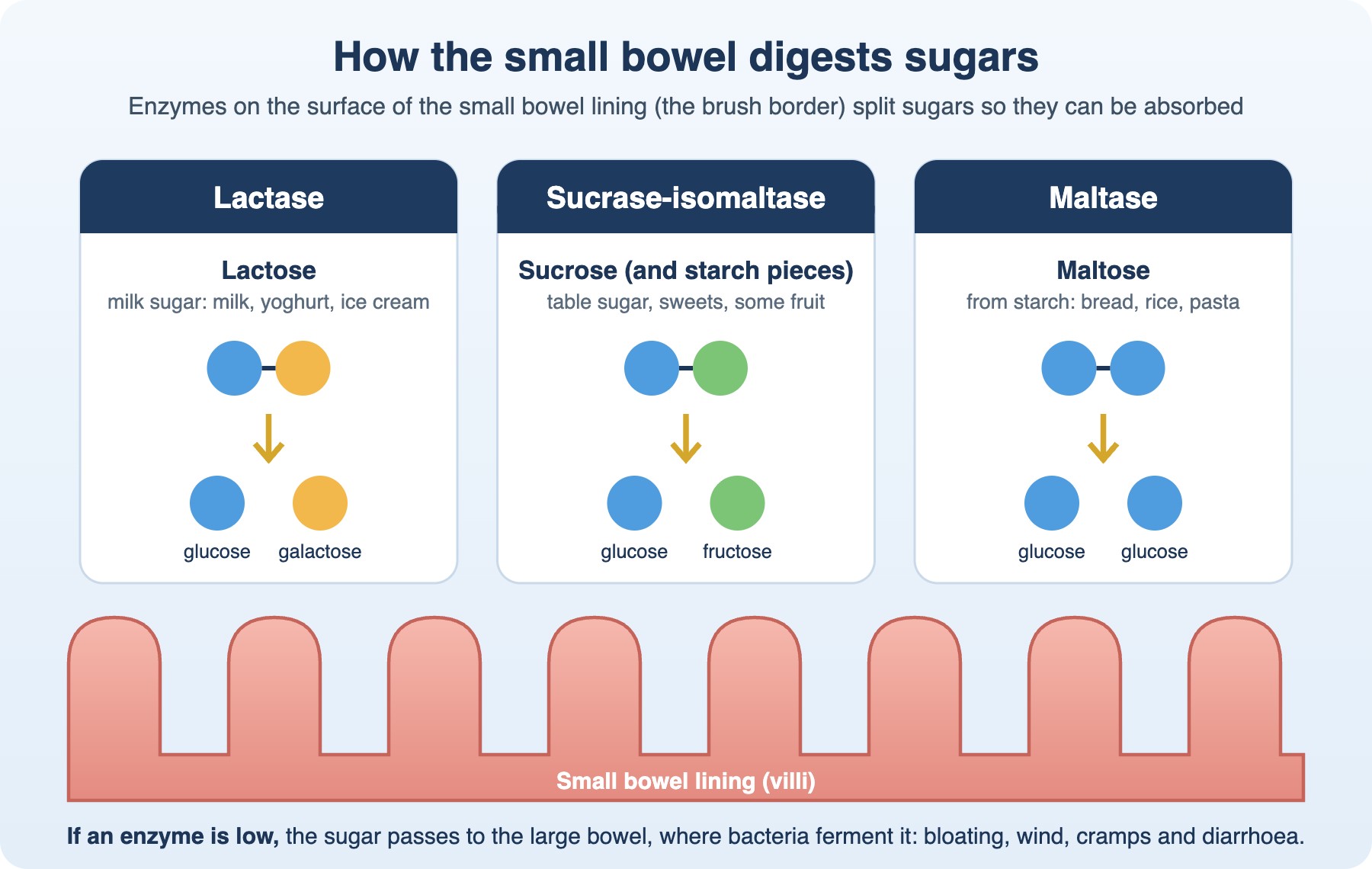
They are digestive enzymes (disaccharidases) on the surface of the small bowel lining. Lactase breaks down lactose, the sugar in milk. Sucrase-isomaltase breaks down sucrose (table sugar) and some starch fragments. Maltase breaks down maltose, which comes from starchy foods such as bread, rice and pasta. If one of these enzymes is low, the undigested sugar passes into the large bowel, where bacteria ferment it, causing bloating, wind, cramps and diarrhoea.
What causes low lactase, sucrase or maltase?
There are two main types. Primary deficiency is inherited. Low lactase in adulthood is very common worldwide, especially in people of Asian, African, Middle Eastern and Southern European background. Congenital sucrase-isomaltase deficiency (CSID) is rare, but milder genetic variants are more common than once thought. Secondary deficiency happens when the small bowel lining is damaged, for example by coeliac disease, Crohn’s disease, gastroenteritis, Giardia, SIBO or chemotherapy. Secondary deficiency often improves once the cause is treated.
What are the symptoms?
Bloating, wind, cramping, rumbling and loose stools, usually within 30 minutes to a few hours of eating the trigger. With lactase deficiency the trigger is dairy. With sucrase-isomaltase deficiency it is table sugar, sweets, desserts, some fruit and, for some people, starchy foods. The symptoms are very similar to IBS, so some people diagnosed with IBS actually have an enzyme deficiency.
How are these enzyme deficiencies tested?
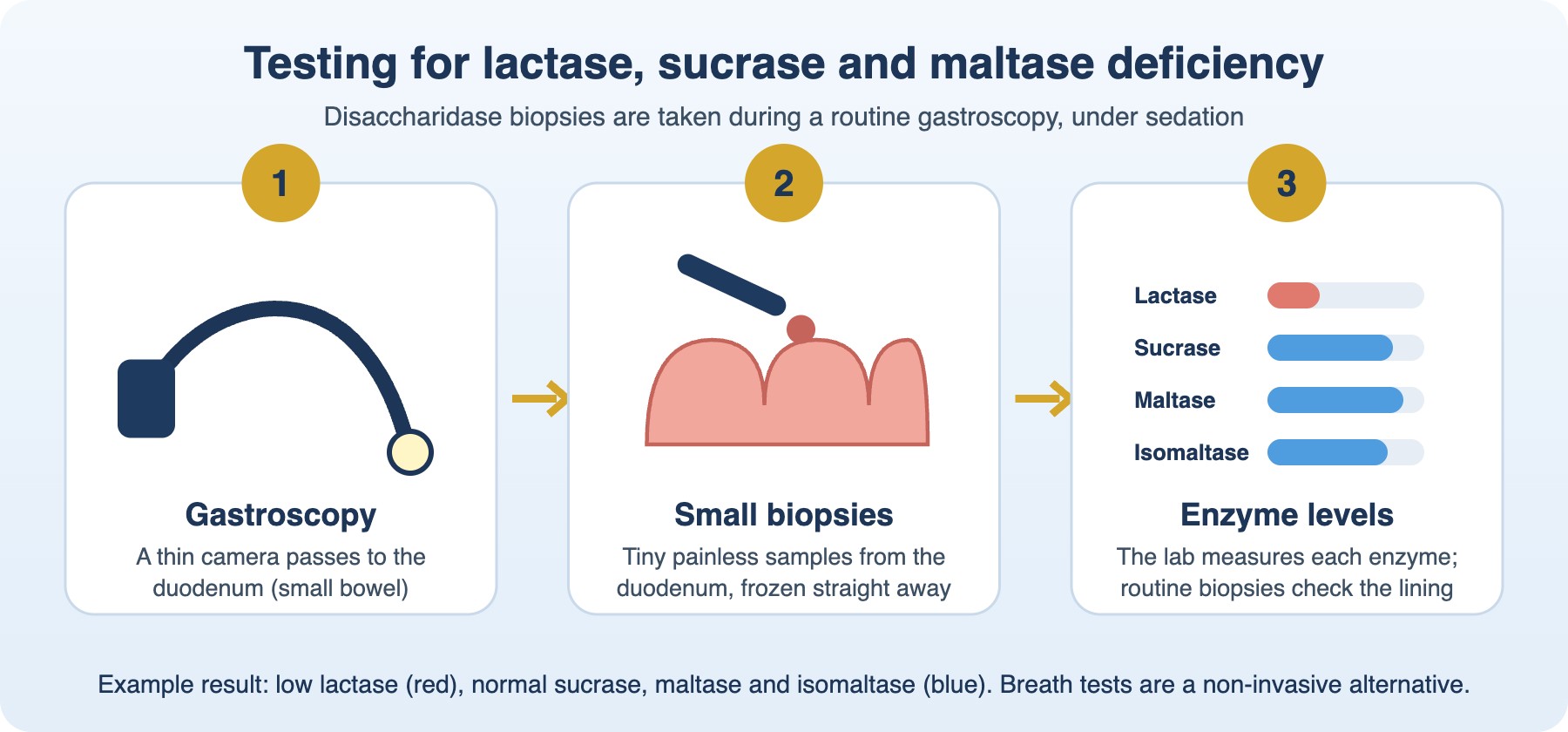
The most direct test is a gastroscopy with small biopsies taken from the duodenum and sent for a disaccharidase assay. The biopsies are frozen straight away and the laboratory measures lactase, sucrase, maltase and isomaltase activity. Routine biopsies are taken at the same time to check for coeliac disease and other causes of damage to the lining. This test attracts a Medicare rebate.
Breath tests are a non-invasive alternative: a lactose breath test for lactase deficiency, and a sucrose breath test where available. A genetic test can show whether you are likely to keep making lactase as an adult.
Guideline: Royal Children’s Hospital Melbourne laboratory: disaccharidase assay (MBS item 66680); Intestinal disaccharidase deficiency in adults: evaluation and treatment, Current Gastroenterology Reports (2023).
How accurate is the biopsy test?
It is the most direct measure of enzyme activity, but results must be read alongside the biopsy findings. Enzyme levels are often low when the lining is inflamed, for example in coeliac disease, so low results in that setting are usually secondary and improve with treatment. Enzymes can also be patchy, so more than one sample is taken. The test is most useful when the lining looks normal under the microscope but symptoms clearly suggest a sugar intolerance.
Guideline: Clinical and histopathologic predictors of disaccharidase deficiency in duodenal biopsy specimens (2019).
How is lactase, sucrase or maltase deficiency treated?
Treatment is mainly dietary, ideally with a dietitian. For lactase deficiency, most people can still have small amounts of dairy, and lactose-free milk, hard cheese and lactase enzyme drops or tablets help. For sucrase-isomaltase deficiency, reducing table sugar and sweet foods and, if needed, some starches usually improves symptoms. An enzyme replacement (sacrosidase) is used overseas for sucrase-isomaltase deficiency but is not readily available in Australia. If the deficiency is secondary, treating the underlying cause, such as coeliac disease or an infection, often lets the enzymes recover.
Guideline: Current Gastroenterology Reports (2023).
Is it the same as lactose intolerance or IBS?
Lactose intolerance is the most common type of disaccharidase deficiency. Sucrase and maltase deficiency are less well known and are often missed. Because the symptoms overlap with IBS, testing is worth considering if symptoms are clearly linked to sugar, dairy or starchy foods, or if they continue despite a low FODMAP diet.
Related procedures and information
Book an appointment
If you have symptoms of lactase, sucrase and maltase deficiency, see your GP or book a consultation with gastroenterologist Dr Ali Zad on (07) 2111 2600 or request an appointment online. You can book directly; a GP referral is needed for a Medicare rebate.
Dr Zad consults and performs procedures across Brisbane and Moreton Bay: Brisbane City and Spring Hill, North Lakes, Caboolture, Everton Park, Taringa and Redcliffe and Kippa-Ring.